

Few morning rituals trigger more primal frustration than watching a supposedly precision-engineered razor sputter to a halt after two strokes, blades packed with sludge like a kitchen sink on Thanksgiving. You tap, you rinse, you shake, but the gunk clings stubbornly, daring you to drag it across your face anyway. Most people blame thick stubble or cheap blades, yet the truth is far murkier—and frankly a little gross.
Hidden in that slurry are protein-laden soap residue, dead skin, and stray beard hair forming a cement tougher than math textbooks. If you want a smooth shave and your sanity back, you need to understand how your routine, environment, and even your choice of shaving products conspire to clog every microscopic gap between the blades.
Table of Contents
Why Clogged Blades Matter More Than You Think
The Micro Soup Brewing in Your Cartridge
What looks like an innocent dollop of shaving cream is, on a molecular level, a bustling city of fatty acids, surfactants, and stabilizers. When lather mixes with cut whiskers and exfoliated skin, it turns into a thick slurry that creeps into the narrow channels engineered for rinse-through.
The more passes you make without rinsing, the more that slurry condenses, creating a glue that defeats water pressure. Imagine pouring oatmeal down a drinking straw—that is what your razor deals with every time you ignore the sink for “just one more swipe.”
The Hidden Hygiene Hazard
A clogged blade is not merely less effective; it is also a petri dish. Warm moisture trapped between metal layers encourages bacterial and fungal growth that can lead to micro-infections, “razor bumps,” and unexplained redness. Each pass of a dirty cartridge basically drags yesterday’s microbial party across today’s freshly opened pores.
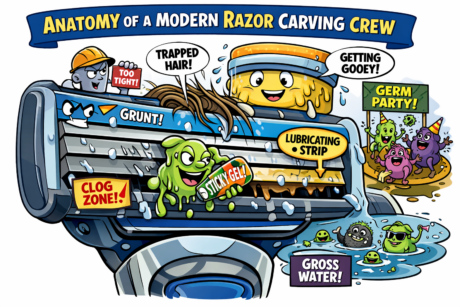
Anatomy of a Modern Razor Carving Crew
How Narrow Gaps Invite Disaster
Multi-blade cartridges promise closeness by stacking three, five, sometimes seven blades in millimeter-thin spaces. Those slivers leave little room for debris to escape, especially once hair fragments wedge sideways. Water struggles to force them free because flow velocity drops inside tight channels, similar to traffic slowing in a tunnel. Over time, each blade pair forms a little dam of grit that blocks the next rinse.
The Lubricating Strip’s Double-Edged Role
Those vitamin-E and aloe strips feel lovely on pass one, but they dissolve into a sticky film after repeated contact with hot water. That film coats hair fragments, making them gummy and more likely to adhere to metal. Ironically, the very feature intended to improve glide can hasten clogging if you linger too long between rinses.
Habits That Pack Your Blades Like Sardines
Shaving in a Hurry
Speed is the enemy of blade hygiene. Rapid strokes without frequent rinses allow debris to accumulate faster than water can wash it away. By pass three, you are effectively planing your beard with a butter knife coated in sludge.
Using Too Much Foam
Marketing loves mountains of lather, but excess cream thickens during the shave, binding hair into larger chunks that wedge and stay put. A golf-ball dollop is more than enough; anything beyond that graduates from cushion to concrete.
Skipping the Pre-Rinse
Splashing your face with warm water before applying cream accomplishes two goals: it softens hair and removes loose dirt. Forgo this step and you introduce environmental grime—pollen, sweat, office dust—directly into the lather, adding more elements ready to lodge in blade gaps.
Cleaning Tricks That Actually Work
Angle the Rinse Like a Pro
Hold the cartridge under a strong faucet stream with the blades facing down and slightly away. Water entering from behind pushes debris out the front rather than further inward. Think of it like flossing the razor instead of hosing the outside shell.
The Toothbrush Technique
Keep an old soft-bristled toothbrush by the sink. After every full face pass, give the blade a gentle swipe perpendicular to its edge. The bristles dislodge stubborn particles without scratching metal or removing the protective coating.
Alcohol Dip for a Quick Detox
After the final rinse, dunk the cartridge for ten seconds in a shot glass of isopropyl alcohol. The alcohol evaporates quickly, carrying residual water with it and leaving fewer minerals behind to form hard scum. It also knocks out bacteria, so your next shave starts cleaner.
Upgrade Your Gear for Easier Maintenance
Single-Blade Safety Razors
A safety razor offers one wide channel behind the blade, making rinsing as simple as a quick swish. Less hardware means fewer nooks for hair to hide. Many users report that switching eliminates clog frustrations entirely.
Open-Comb Designs
For those who prefer cartridge convenience, look for open-comb or “flow-through” head layouts. These designs carve broader gaps that let bulk debris escape rather than pile up. Water jets straight through, carrying foam and cut stubble along for the ride.
Cartridges With Non-Stick Coatings
Newer premium cartridges feature hydrophobic coatings inspired by cookware technology. Water beads and slides off, dragging debris with it. While pricier up front, these blades last longer because they resist buildup that blunts edges.
Conclusion
Your razor clogs because you are feeding it a sticky stew of soap, skin, and stubble, then expecting millimeter-thin channels to act like fire hoses. The fix sounds simple: use moderate lather, rinse often and correctly, give blades an occasional toothbrush scrub, and choose equipment designed for easy flow. Follow these habits and your morning shave will glide rather than grind, leaving you with a face you want to show the world instead of a clogged metal reminder of what went wrong.